
Leader in IT Support & Cybersecurity Across Ontario

Blog
April Fools Jokes Are Over, but These Scams Aren't Fun Pranks
Powered By Cairitech
3 min read posted on 04/05/26
Spring is one of the most productive seasons for hackers. Not because teams are careless, but because everyone's busy, a little distracted and moving fast. That's when the almost-believable stuff slips through, the kind that blends into a normal workday and doesn't feel dangerous until it's too late.
Here are three scams working right now. Not on gullible people, but on sharp, well-meaning employees who are just trying to get through their day.
As you read through these, ask yourself one honest question: Would everyone on my team pause long enough to catch each one?
Scam #1: The Toll Road (or Parking Fee) Text
An employee gets a text message: "You have an unpaid toll balance of $6.99. Pay within 12 hours to avoid late fees."
It names a real toll system — 407 ETR, Highway 407, or a municipal parking authority — whatever matches the province they're in. The amount is small enough not to trigger alarm bells. They're between meetings, so they click, pay and move on.
Except the link wasn't real.
The Canadian Anti-Fraud Centre has flagged a sharp rise in fake toll and parking fee texts, mirroring a trend that saw over 60,000 complaints filed with authorities in 2024 alone, with volume jumping 900% in 2025. Researchers have identified tens of thousands of fake domains set up specifically to impersonate provincial and municipal toll and parking systems — a level of infrastructure that tells you how profitable this scam has become. Some of these texts have even reached people in provinces without any toll roads.
The reason it works is simple: $6 dollars doesn't feel risky, and most people have driven through a toll or parked downtown recently, so the message feels completely plausible.
The guardrail that helps: Legitimate toll agencies don't demand immediate payment via text. Smart businesses make it a rule: No payments happen through text-message links. If something might be real, employees go directly to the official website or app themselves. They never reply — not even "STOP" — because responding confirms the number is active and invites more.
Convenience is the bait. Process is the defence.
Scam #2: 'Your File Is Ready'
This one blends perfectly into everyday work.
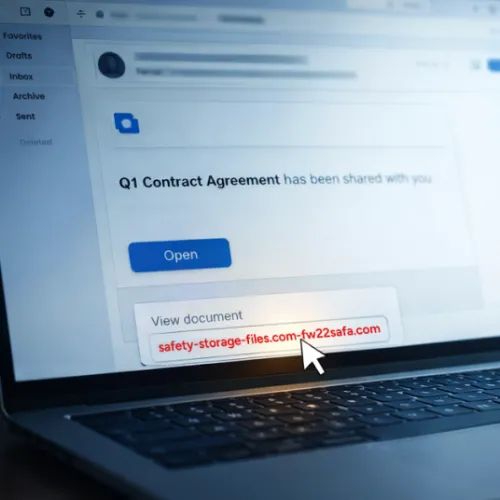
An employee receives an email stating that a document was shared with them. It's usually something ordinary like a contract in DocuSign, a spreadsheet in OneDrive or a file in Google Drive.
The sender's name looks right. The formatting looks exactly like every other file-share notification they see.
They click. They're prompted to log in. They enter their work credentials.
Now someone else has them, and if they used their work login, the attacker is inside your company's cloud environment.
This type of attack has exploded. Phishing campaigns abusing trusted platforms like Google Drive, DocuSign, Microsoft and Salesforce increased 67% in 2025, according to KnowBe4's Threat Labs. Google Slides-based phishing links alone spiked over 200% in a recent 6-month period.
Even more alarming, employees are seven times more likely to click a malicious link from OneDrive or SharePoint than from a random email because the notification looks identical to the real thing.
The newer versions are even harder to catch. Attackers create files inside compromised accounts and use the platform's own sharing feature to send the notification. That means the email actually comes from Google's or Microsoft's real servers. Your spam filter doesn't flag it because, technically, it's a legitimate notification.
The guardrail that helps: If a shared file wasn't expected, employees are trained not to click the link in the email. Instead, they open their browser and log into the platform directly. If the file is real, it'll be there. Businesses also reduce risk by restricting external file-sharing permissions and enabling alerts for unusual login activity — two settings your IT team can configure in about 15 minutes.
Boring habit. Very effective result.
Scam #3: The Email That's Written Too Well
Remember when phishing emails were easy to spot? We were trained to look out for broken grammar, strange formatting and obvious nonsense.
Those days are over.
A 2025 academic study found that AI-generated phishing emails achieved a 54% click rate, compared to just 12% for human-written ones. That's more than four times as effective. The reason is straightforward: These emails don't look like scams anymore. They reference real company names, real job titles and real workflows, all scraped from LinkedIn and company websites in seconds.
The newest twist is departmental targeting. Your HR and payroll team gets fake employee verification requests. Your finance person gets vendor payment redirects. In one recent test, 72% of employees engaged with a vendor impersonation email — 90% higher than other types of phishing. The messages are calm, professional and urgent without being dramatic. They look like a normal Tuesday in your team's inbox.
The guardrail that helps: Any request involving credentials, payment changes or sensitive data gets verified through a second channel, be it a phone call, a chat message or a walk down the hall. Before clicking any link, employees hover over the sender's email address to check the actual domain. And when an email creates urgency, the urgency itself is treated as the warning sign.
Real security doesn't need to panic people into clicking.
What This Really Comes Down To
All of these scams rely on familiarity, authority, timing and the assumption that "this will only take a second."
That's why the real risk isn't a careless employee. It's systems that assume everyone will always slow down, double-check and make the perfect call under pressure.
If one rushed click could derail your day, that's not a people problem, it's a process problem.
And process problems are fixable.
That's Where We Can Help
Most business owners don't want to turn this into another project or become the person responsible for teaching everyone what not to click.
They just want to know their business isn't quietly exposed.
If you're concerned about what your team might be dealing with — or you know another business owner who probably should be — we're happy to have a conversation.
Schedule a straightforward discovery call where we'll talk through:
The kinds of risks businesses like yours are seeing right now.
Where issues tend to sneak in through normal, everyday work.
Practical ways to reduce exposure without slowing people down.
No pressure. No scare tactics. Just a chance to surface concerns and talk through options for eliminating them.
If this isn't for you, feel free to forward it to someone who'd appreciate the heads-up. Sometimes knowing what to look for is all it takes to turn a "would have clicked" into a "nice try."
Book your free 10-minute discovery call with Cairitech today.
FREE REPORT: IT Buyers Guide
What You Should Expect To Pay For I.T. Support For Your Business (And How To Get Exactly What You Need Without Unnecessary Extras, Hidden Fees And Bloated Contracts)
Popular Reads You Don’t Want to Miss
March 29, 2026
Cyber resilience is no longer optional for Ontario manufacturers and builders. Learn how downtime, cyber risk, and outdated IT can quietly threaten your operations—and what smart business leaders are doing in 2026 to stay secure, compliant, and competitive. [Read more]

January 17, 2025
If you think hackers are only targeting Fortune 500 companies, think again. Thanks to artificial intelligence, cybercriminals now have the power to scale their attacks like never before - and small business owners are at the top of their hit list. Here’s how hackers are weaponizing AI... [Read more]

LOCATIONS
Canada
1-2 Vata Court, Aurora, ON
United States
39288 Calle Tonala, Indio, CA
PRODUCT
COMPANY
SUPPORT
CONNECT
Copyright 2026. Cairitech. All rights reserved.